


In Nepal, banking is often seen as one of the most rewarding sectors for salaries and perks. Bank employees enjoy good monthly pay, annual bonuses, and other benefits. But few know that another government body has been paying its staff far more and that too from funds meant for the state treasury.
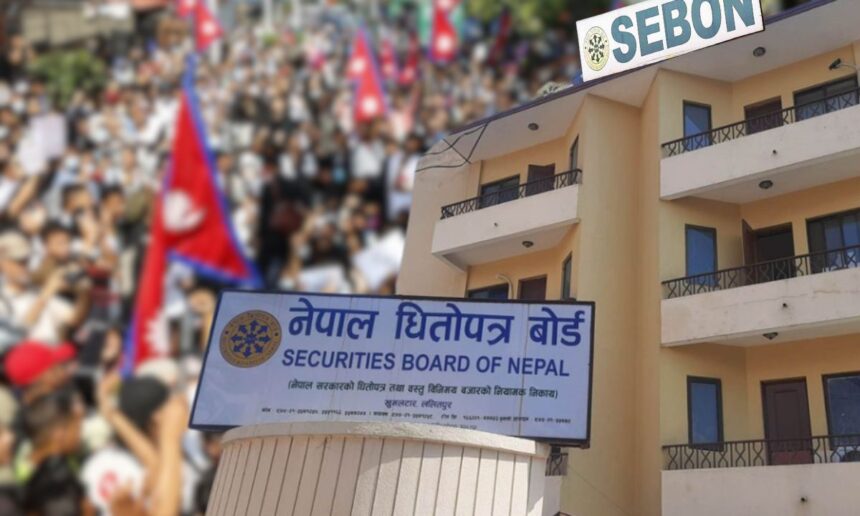
This institution is the Securities Board of Nepal (SEBON). According to a report by the Commission for the Investigation of Abuse of Authority (CIAA), SEBON staff receive almost double the benefits compared to other government employees of the same rank. The report accuses the board of creating and using multiple internal funds without legal approval and distributing public money as personal perks.
Staff in protest
SEBON employees have been protesting for more than 40 days. The protest began after the Finance Ministry ordered the shutdown of some internal welfare and protection funds, calling them illegal. The ministry also demanded that the extra money taken from these funds be returned to the state.
Despite work at SEBON being halted for over a month, the interim government has yet to take firm action against the striking employees.
What the CIAA found?
The CIAA’s confidential report reveals that SEBON employees receive almost twice as much pay as other civil servants, plus extra allowances through funds like the Employee Welfare Fund and Protection Fund. These funds were created from SEBON’s annual savings without Finance Ministry approval.
According to the report, the Welfare Fund alone received a large portion of SEBON’s savings every year. The contribution rules were unusually generous a quarter of the saved amount for smaller budgets and at least 10% for larger ones, with minimum payouts reaching up to tens of lakhs of rupees.
The fund also allows staff to take interest-free loans for personal reasons such as weddings, education, or medical treatment. Employees who retire after 20 years can receive five years’ worth of salary as a lump sum, while those who serve 15 to 20 years get three and a half years’ pay. The CIAA called these provisions a serious misuse of public funds.
Weak governance, strong benefits
The report also questioned SEBON’s performance. Despite heavy salaries and perks, the commission said there had been no noticeable improvement in Nepal’s capital market or SEBON’s governance. Complaints received by SEBON were poorly handled, and oversight of the market remained weak.
Finance Ministry’s response
Following the CIAA’s findings, the Finance Ministry sent a letter to SEBON on Asoj 2 directing it to dissolve the illegal funds and recover all misused amounts. The ministry warned that such actions weaken financial discipline and could damage the country’s economy if left unchecked.
The report also raised concerns about senior officials who served as SEBON board members at different times, questioning why they did not oppose these irregular decisions.
The CIAA’s directive
The CIAA concluded that SEBON’s internal funds were set up and operated in violation of law. It urged the government to take corrective steps, ensure all state agencies follow uniform salary and benefit standards, and report back to the CIAA within a month.
The agency warned that if public institutions continue diverting state money for employee perks, it could seriously harm Nepal’s financial discipline and credibility.
