


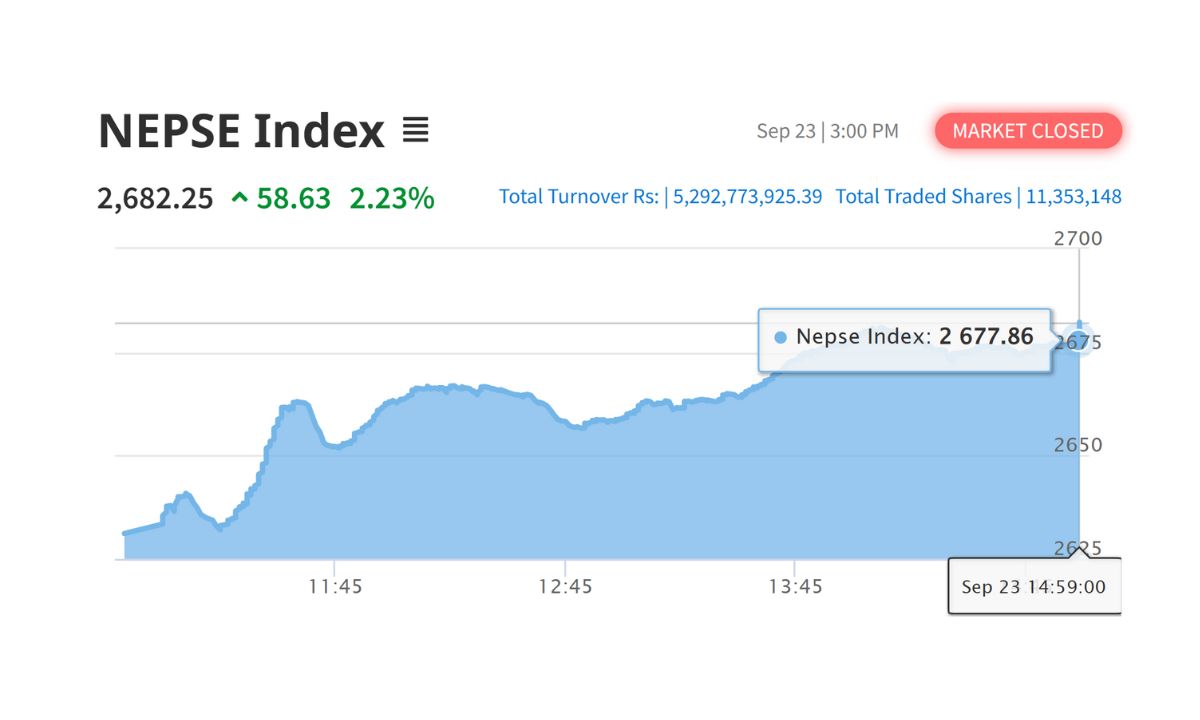
Nepal Stock Exchange (NEPSE) increased sharply on September 23, closing at 2,682.25 points, up 58.63 points or 2.23%. The total trading value reached Rs 5.29 billion, with 11.35 million shares traded.
A major reason for the rise was the increase in share prices of weak banks and financial institutions. These include ultra-low-cap banks and companies with poor financial health, low per-share net worth, low earnings, limited distributable profits, and high non-performing loans. Their shares began rising rapidly after NEPSE suspended the “last 15-minute average” rule for calculating the index and trading prices.
This rule had been introduced five months ago to prevent price manipulation in companies with few shares. However, it reduced investor confidence and led to criticism. Following the Gen Z protests, the Securities Board of Nepal allowed NEPSE to suspend the rule and return to the old system for calculating share prices and the market index.
Since the old system was reinstated, some groups involved in trading manipulations have become active again. On September 23, this was seen clearly. Several companies, including Saptakoshi Development Bank, Joshi Hydropower, Green Development Bank, Narayani Development Bank, and Sindhu Development Bank, saw positive circuits in their share prices.
These movements in weak company shares contributed to today’s market gain, showing active trading and renewed investor interest.
